Dark Matter Energy Theory
Version 1.4 — August 2026
A speculative geometric framework built around one central question: what if dark matter and dark energy are not separate unknown substances, but large-scale consequences of gravity and spacetime curvature? The model starts with the familiar principle that mass-energy curves spacetime, then explores whether that same gravitational geometry could remain important at galactic scales and across a larger connected cosmic structure.
Mass creates curvature. Curvature governs motion. The same underlying physics that explains falling objects, orbital motion, accretion and gravitational lensing is therefore taken as the starting point for explaining the effects normally attributed to dark matter and dark energy.
Read the original idea in plain language, without the mathematical detail.
📄 Read the idea in 2 minutes — Plain-Language Overview
Permanent research record: Zenodo DOI 10.5281/zenodo.22177398
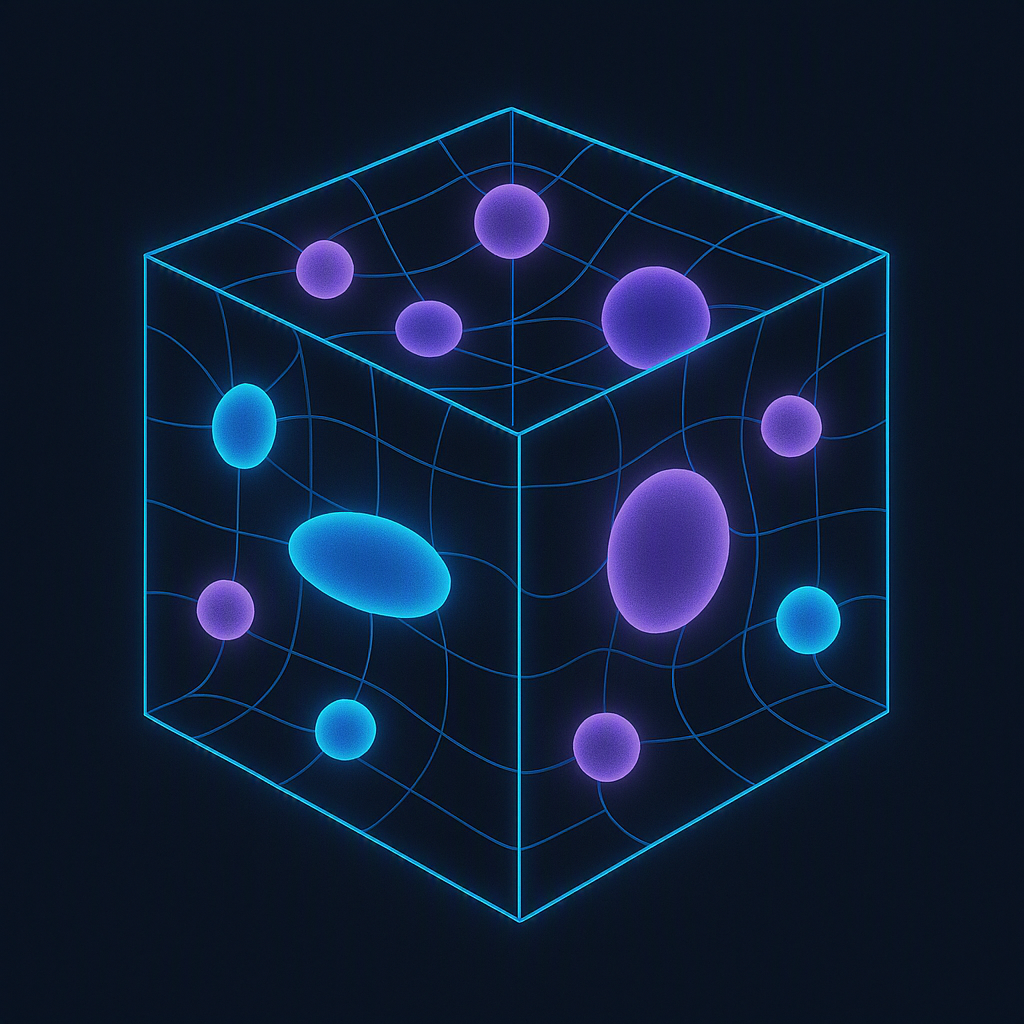
Gravity Is the Unifying Mechanism
DMET does not begin by adding a new invisible substance. It begins with the physics already used to describe gravity: mass-energy curves spacetime, and that geometry determines how matter and light move. The proposal asks whether a larger connected geometry could make the gravitational influence of ordinary mass extend differently from the standard four-dimensional expectation.
Galactic scale — apparent dark matter
Stars, gas and the central mass concentration all contribute to the galaxy's gravitational geometry. DMET explores whether the combined curvature can remain influential farther from the visible matter, producing the additional orbital and lensing effects normally assigned to a dark-matter halo.
Large scale — apparent dark energy
If other massive universe-regions exist on a larger connected geometry, their surrounding curvature could produce direction-dependent gravitational gradients. DMET explores whether the resulting large-scale tidal or tensional response could contribute to accelerated expansion.
Why This Matters
Modern cosmology relies on invisible components — dark matter, dark energy, and unexpectedly massive early galaxies. This theory asks a different question:
What if these effects are not new substances, but consequences of the geometry of the membrane our universe sits on?
- Dark Matter hypothesis: additional galactic gravity is an extended geometric response rather than necessarily a new particle halo.
- Dark Energy hypothesis: large-scale curvature gradients and membrane strain/tension contribute to accelerated expansion.
- Neighbouring-region extension: other massive universe-regions, if they exist, contribute external curvature to the larger geometry.
- JWST extension: a subset of apparently very early mature galaxies could instead be light from galaxies in another region, altered and/or lensed by the boundary geometry.
JWST and the Boundary‑Region Effect
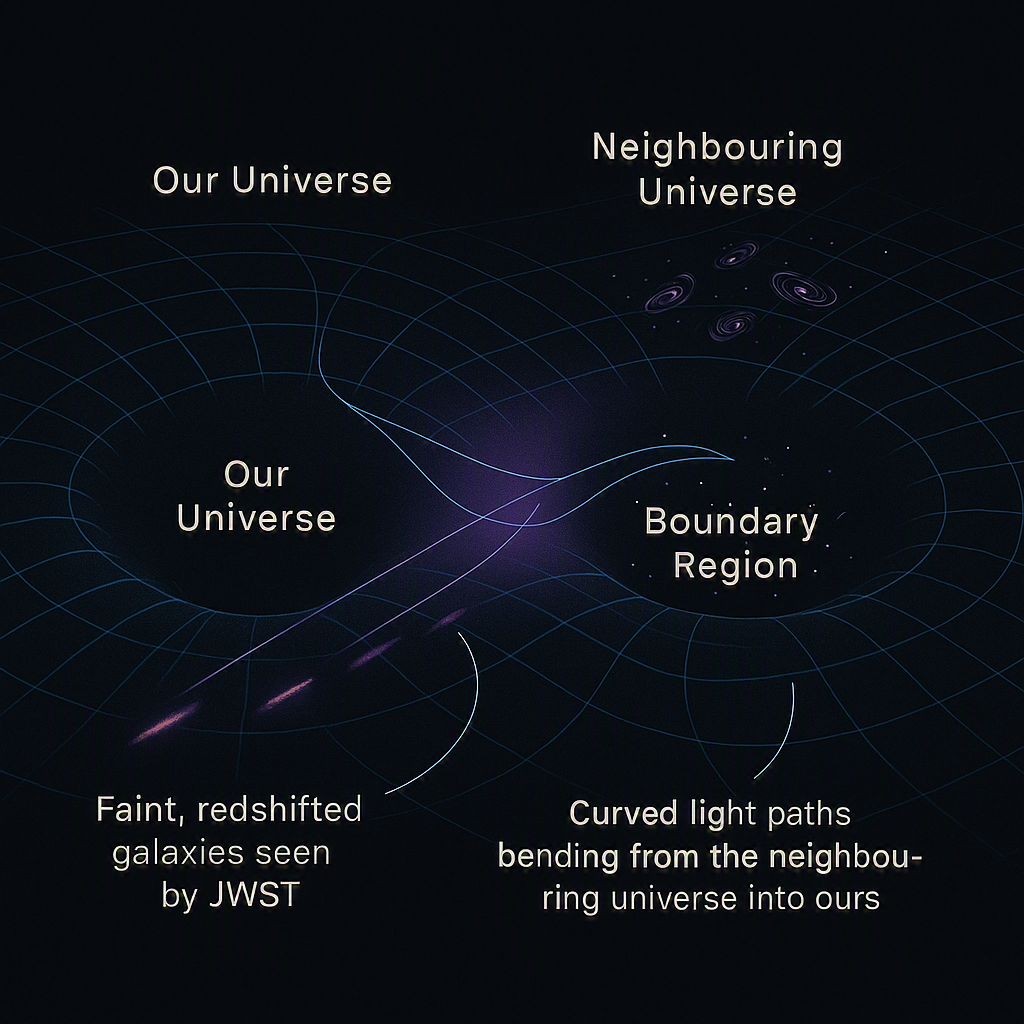
One speculative extension of DMET asks whether a subset of unusually mature-looking high-redshift sources could be galaxies belonging to another universe-region rather than young galaxies in our own early universe. In that picture, their light would have to propagate through the geometry between regions before reaching us. The same boundary geometry could affect the light in two distinct ways: deflection/magnification through gravitational lensing and a change in observed photon frequency — a boundary-induced geometrical redshift.
This factorised expression is a conceptual guide rather than a fundamental DMET equation. In a relativistic calculation the observed frequency must be obtained from the complete photon path, the emitter, the boundary geometry and the observer.
This boundary‑region visibility effect is one of the most distinctive and testable predictions of the theory. It is explored in detail in the full theory and illustrated in the diagram gallery.
Core Ideas at a Glance
- Membrane Universe: Our universe is a curved region on a larger membrane.
- Dark Matter as Curvature: Extra gravity arises from extended curvature basins.
- Dark Energy as a Geometric Effect: External curvature gradients may produce large-scale tidal strain and an effective tensional response that contributes to accelerated expansion.
- Neighbouring Universes: Adjacent curvature wells with overlapping fields.
- Testable Predictions: Rotation curves, lensing patterns, expansion gradients, JWST anomalies.
How to Explore the Site
- Basics: A simple, non‑technical introduction.
- Model: The geometric structure of the membrane universe.
- Theory: The full scientific proposal, step by step.
- Gallery: All diagrams used throughout the theory.
- About: Background and motivation.
- Feedback: Send comments or scientific critique.