The Full Theory
This page presents the Dark Matter Energy Theory as a structured speculative framework. Its organising principle is deliberately simple: mass-energy creates curvature, curvature produces gravity, and the same gravitational geometry is explored across local, galactic and inter-region scales. Dark matter, dark energy and the JWST boundary proposal are therefore treated as different possible manifestations of one underlying mechanism rather than three unrelated mysteries.
Step 1 — The Membrane Universe Model
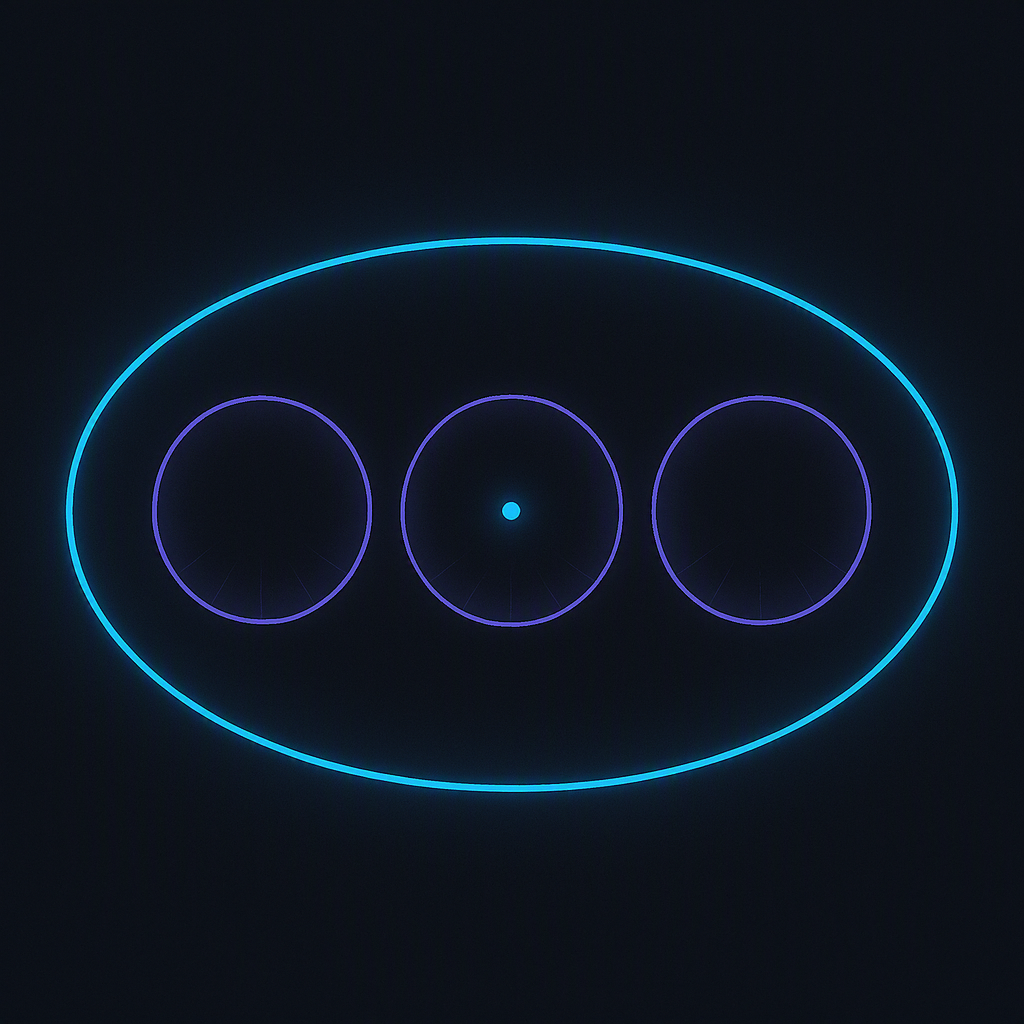
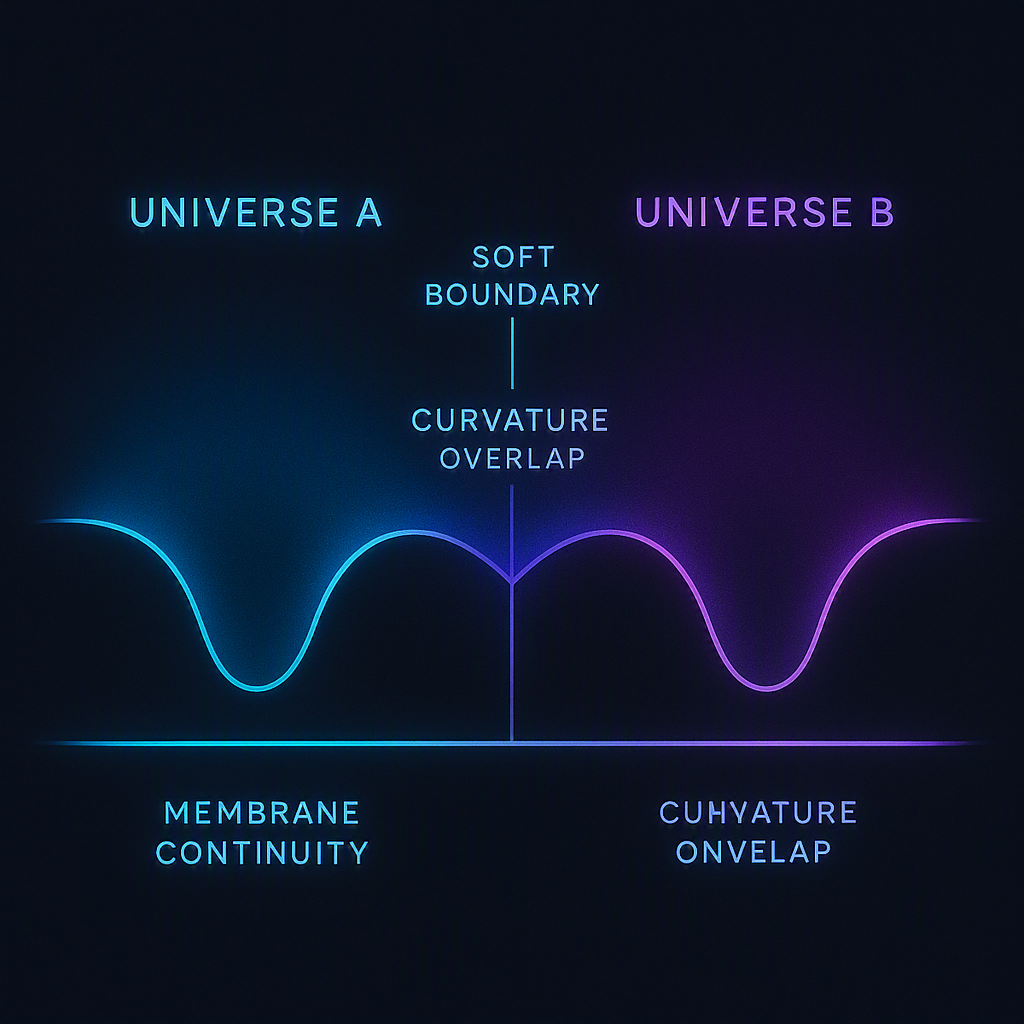
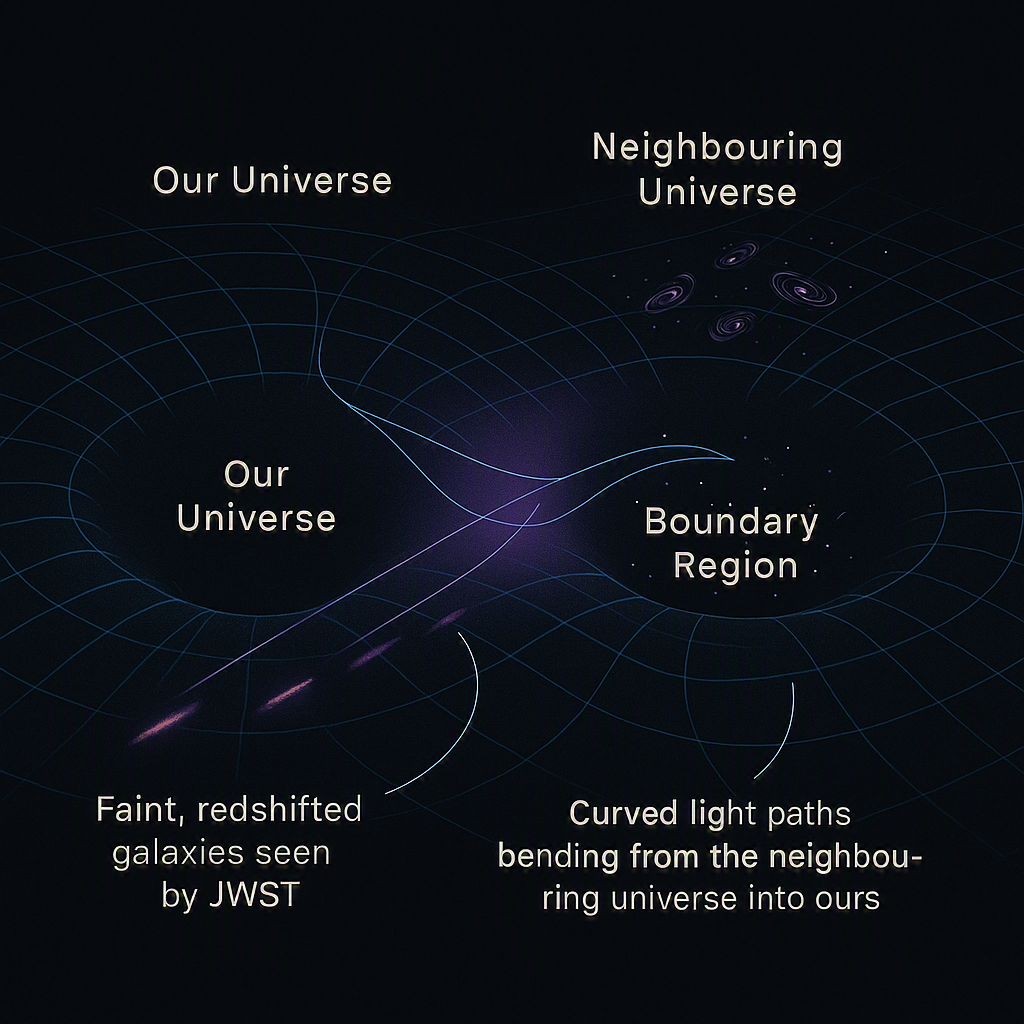
The foundation of the theory is that our universe is a curved region on a larger cosmic membrane. This membrane contains many regions, each behaving like its own universe. These regions have soft, overlapping boundaries where curvature and light can interact.
Key Principles
- Our universe is a curvature well on a continuous membrane.
- Neighbouring universes are adjacent curvature wells.
- Boundaries between universes are gradual, not sharp.
- Curvature can extend beyond our visible horizon.
- Light can bend across boundaries under the right conditions.
Step 2 — Gravity as Curvature
The starting principle — that mass-energy curves spacetime and that this geometry governs motion — comes from General Relativity. DMET then makes the additional speculative proposal that our observable universe is one curvature region within a larger connected geometry.
The following diagrams show how curvature behaves around single and multiple masses.


Step 3 — Dark Matter as Extended Curvature
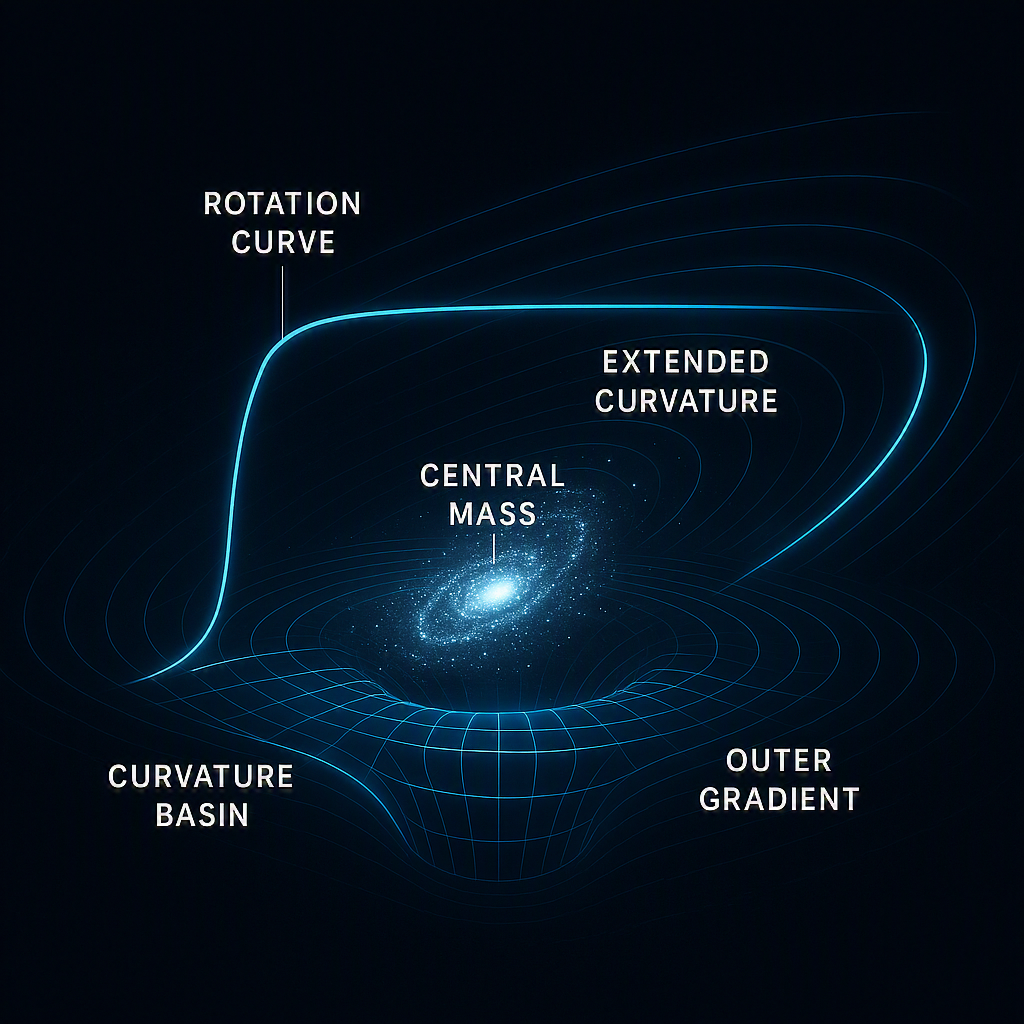
DMET asks whether the additional gravity conventionally attributed to dark matter can instead be an extended response of spacetime geometry to the galaxy's ordinary mass-energy. Stars, gas and the central mass concentration all contribute to the total field. The central black hole is one contributor, but the model does not require it to dominate the outer galaxy.
The crucial claim is not merely that mass curves spacetime — General Relativity already says that. DMET must ultimately specify why the larger membrane geometry changes the effective relationship between visible mass and curvature at low accelerations or large distances.
This is a provisional phenomenological equation, included to show the kind of mathematical law the theory must supply. It is not claimed as a derived fundamental equation of DMET.
How the Proposed Mechanism Would Work
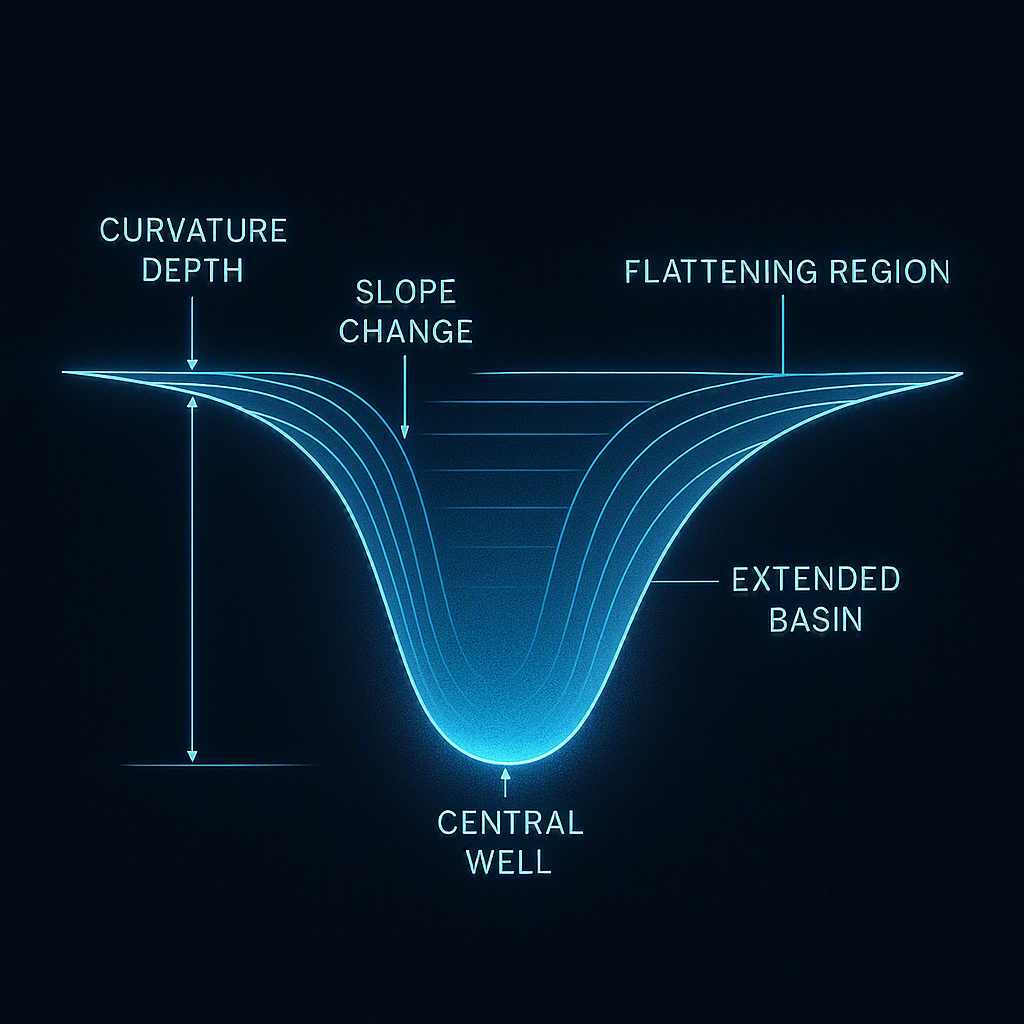
- Galaxies sit in wide curvature basins.
- These basins extend far beyond the visible stars.
- Rotation curves flatten because the curvature is deeper and wider.
- No exotic particles are required.
Step 4 — Neighbouring Universes
Other regions on the membrane are hypothesised to behave as neighbouring universes. Because each contains mass-energy, each would also contribute curvature to the larger geometry. Their masses, positions and separations could therefore create an external field around our own region.
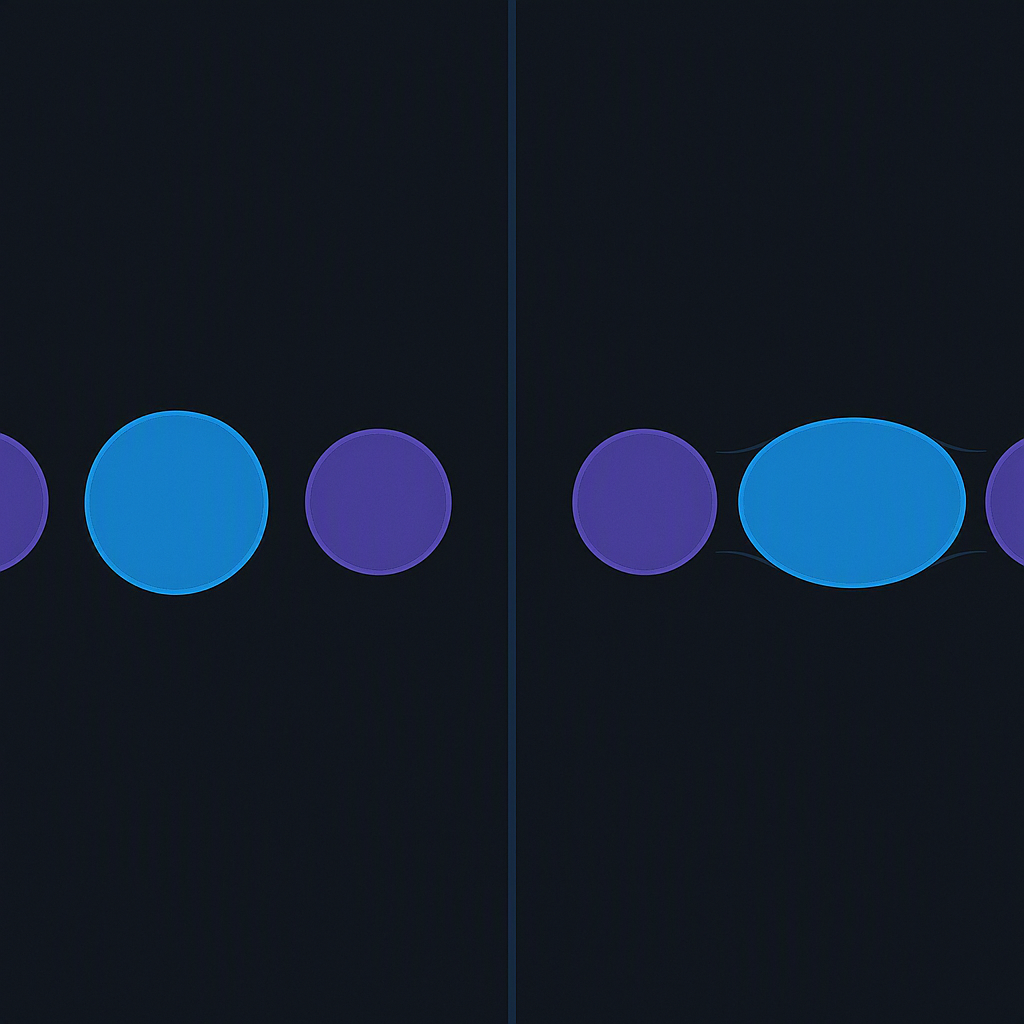
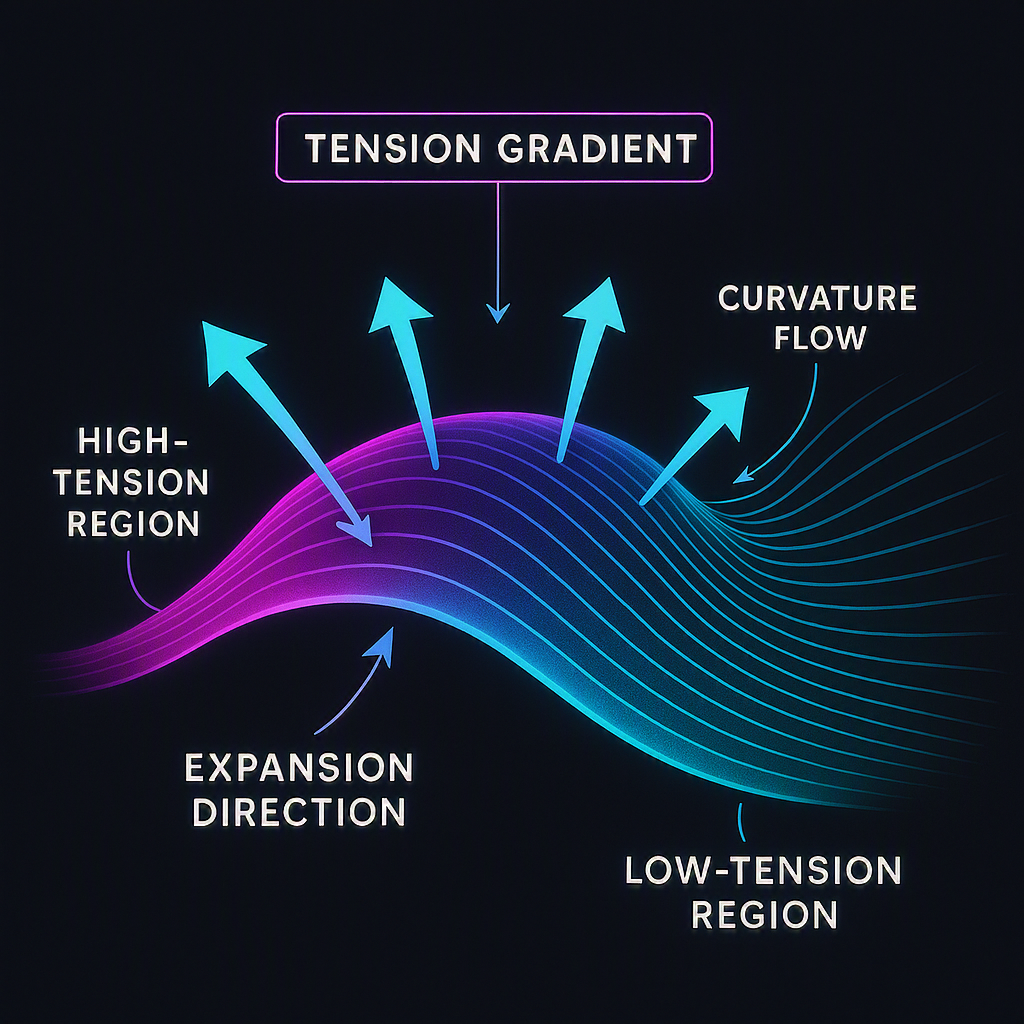
The physically important quantity for DMET is the gradient of that external field. A uniform pull would accelerate our entire region together; a tidal gradient can change the relative acceleration of separated locations and is therefore the more relevant route to an expansion effect.
Step 5 — Dark Energy as a Large-Scale Gravitational / Tensional Effect
DMET does not treat dark energy as a separate repulsive substance. The working idea is that the combined curvature of neighbouring massive regions produces large-scale tidal gradients across the membrane. Those gradients may strain the larger geometry, producing an effective tension or negative pressure that changes the expansion of our region.
Consequences to Test
- The effect should arise from geometry rather than a separately inserted dark-energy substance.
- Any directional component must be small enough to satisfy existing isotropy constraints.
- The theory must predict an expansion history that can be compared with supernova, BAO and CMB data.

Step 6 — JWST and the Boundary‑Region Visibility Effect
JWST has identified high-redshift galaxies whose inferred masses, luminosities, or apparent maturity have prompted continuing investigation into early galaxy formation. In DMET, a speculative possibility is that a subset of such objects may not belong to the early history of our own universe.
The Speculative Explanation
Near a boundary between curvature regions, DMET allows the possibility that light from a mature galaxy in another universe-region could propagate into a path that reaches our observers. Two effects must be distinguished. Gravitational lensing can bend, magnify and distort the image. Separately, the changing geometry, gravitational potential and/or motion of the boundary can alter the photon's measured frequency, producing an additional boundary-induced geometrical redshift.
The relativistic starting point is not a statement that 'lensing makes light red'. An observer with four-velocity u measures a photon of wave-vector k with frequency
A cross-region model must therefore calculate the emitted and observed frequency from the complete null path through both regions and the boundary. Schematically, it is useful to think of the measured redshift as containing several multiplicative contributions:
This factorisation is explanatory shorthand. The full relativistic calculation uses the spacetime metric and photon four-momentum rather than treating these terms as independent adjustable numbers.
If a significant part of an object's observed redshift came from the inter-region geometry, then using the entire redshift as an ordinary distance/lookback-time indicator could make a mature galaxy from another region appear to be an unexpectedly large galaxy in the very early universe.
This proposal requires much more than an unusual image. A successful boundary interpretation would need to explain the object's complete spectrum, apparent redshift, angular size, lensing geometry, flux, surface brightness and time-dependent behaviour. For a non-dispersive geometric mechanism, all identified spectral features must yield the same redshift; temporal processes should also show the corresponding time-stretching unless the model predicts and derives a different relation. Conventional high-redshift explanations remain the baseline comparison.
Key Observational Requirements
- All identified spectral lines must give one coherent redshift for a non-dispersive boundary.
- The lensing/magnification pattern must follow from the same boundary geometry used for propagation.
- Flux and surface brightness must be consistent with transmission, magnification and the altered distance-redshift mapping.
- Time-dependent signals should show the redshift-related temporal stretching predicted by the model.
- Candidate objects should show a reproducible angular or environmental pattern if a common boundary geometry is involved.
Step 7 — Predictions and Testable Consequences
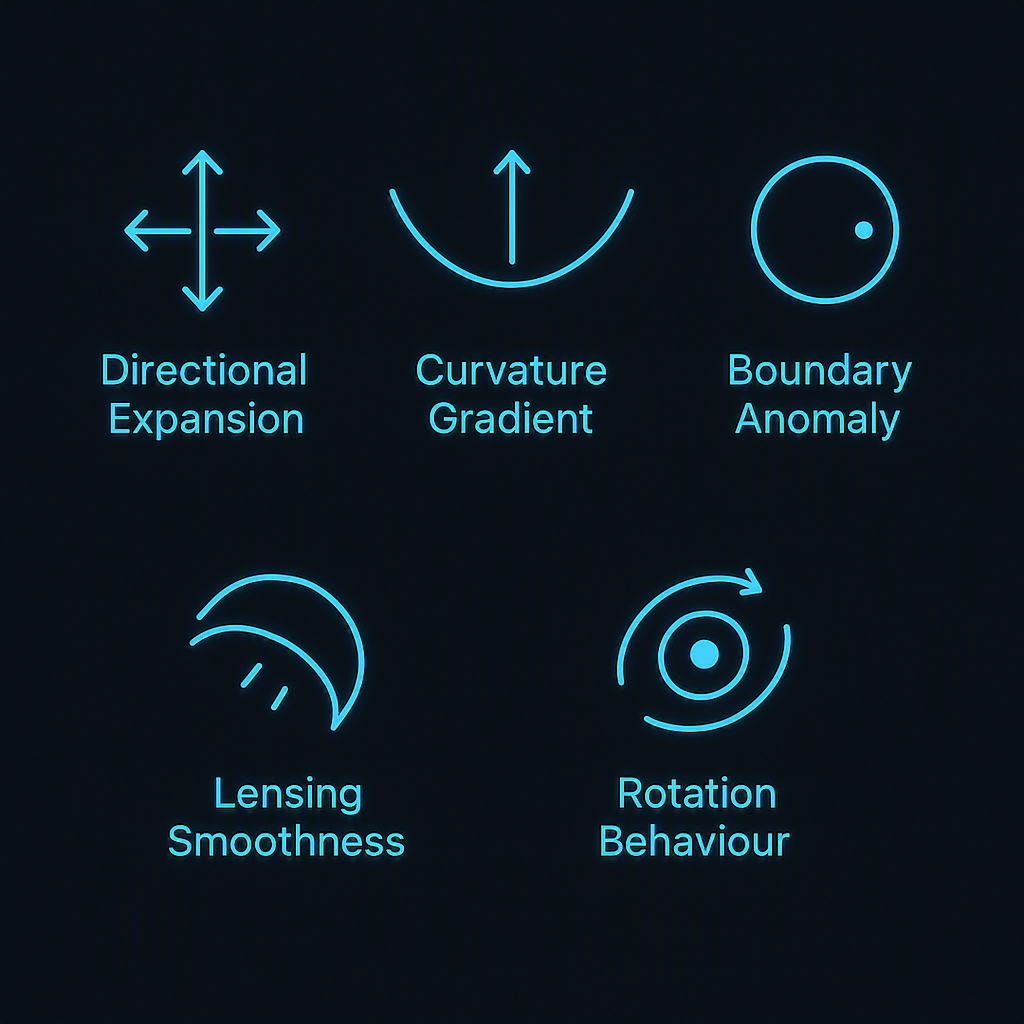
A scientific theory must make predictions. This model leads to several testable outcomes:
1. Gravitational Lensing
- The same curvature law used to explain orbital motion must also reproduce observed lensing.
- DMET should predict a measurable lensing pattern or small-scale structure spectrum that differs from a particle-halo model.
- For the neighbouring-region extension, any apparent boundary galaxy must have a lensing/propagation signature consistent with the proposed geometry.
2. Galaxy Rotation Curves
- Rotation speeds should follow curvature profiles.
- No sharp halo boundaries should appear.
3. Expansion Variations
- Expansion should vary by direction due to membrane tension.
- Regions with higher curvature gradients should expand faster.
4. JWST / Boundary-Origin Candidates
- Any proposed candidates should show a consistent combination of geometrical redshift, lensing and magnification predicted by one boundary model.
- Different spectral lines must agree on the same observed redshift unless the theory explicitly introduces and predicts dispersion.
- The inferred population should exhibit a testable sky distribution or correlation with the proposed boundary geometry.
These predictions allow the theory to be tested against real data.
Step 8 — What Would Falsify or Seriously Challenge DMET?
Galaxy dynamics
If no single curvature law can predict rotation curves from the observed baryonic mass distribution, the core dark-matter proposal fails.
Lensing
If the same geometry that fits galaxy motion cannot reproduce gravitational lensing, the model is incomplete or wrong.
Cosmic expansion
If the proposed tidal/tensional mechanism cannot produce the observed expansion history while respecting isotropy constraints, the dark-energy extension fails.
JWST boundary hypothesis
If boundary propagation cannot reproduce coherent spectral redshift, time behaviour, flux and distinctive lensing signatures from one geometry, the neighbouring-galaxy interpretation should be rejected even if the core DMET idea survives.