About This Project
The Dark Matter Energy Theory is an independent research project developed by Derek Anderson Orr. It began as a simple question: before introducing separate unknown substances, can we push the physics of gravity and spacetime curvature farther? Over time, that question grew into a geometric model exploring dark matter, dark energy, neighbouring universe-regions, and possible boundary interpretations of some deep-field observations.
How the Idea Began
DMET began as an intuitive idea rather than a mathematical derivation. The original question was simply whether dark matter and dark energy might ultimately be effects of gravity and spacetime geometry, rather than separate unknown substances.
A second idea followed from reports of unexpectedly mature high-redshift galaxies: if other universe-regions exist, could some of their galaxies become visible to us through a larger connected geometry? In the present model, that possibility is treated as a separate and highly speculative extension involving cross-region light propagation, possible geometrical redshift, and lensing.
The mathematical work on this site was developed later to explore what equations, predictions, observational tests, and failure criteria those original ideas would require.
A short two-page overview explains the concept in the same plain-language form in which it began.
📄 Read the idea in 2 minutes — Plain-Language Overview
Permanent research record: Zenodo DOI 10.5281/zenodo.22177398
Why This Theory Was Created
Modern cosmology is remarkably successful, yet the physical nature of dark matter and dark energy remains unresolved. This project deliberately starts from something already established: mass-energy curves spacetime and curved spacetime governs motion and light. It asks whether a larger connected geometry could make that same physics appear as additional galactic gravity and as a large-scale contribution to cosmic expansion.
The idea that gravity, curvature, and membrane tension could explain these phenomena is not new, but combining them into one speculative, testable framework is the purpose of this work.
How the Model Developed
The theory grew from a series of simple geometric sketches: curvature wells, membrane surfaces, and boundary regions between neighbouring universes. As these diagrams became more refined, a pattern emerged:
- Dark matter may reflect an extended gravitational/geometric response to ordinary mass-energy.
- Dark energy may reflect large-scale curvature gradients together with a tidal or tensional response of the larger geometry.
- The JWST boundary-region idea is a separate, highly speculative optical extension in which the geometry may produce both lensing and an additional cross-region redshift; it must satisfy spectral, timing, flux and lensing tests.
- Gravity and spacetime curvature are the unifying physical starting point across all parts of the model.
What began as a visual exploration gradually formed into a structured model with testable predictions.
The Role of Diagrams
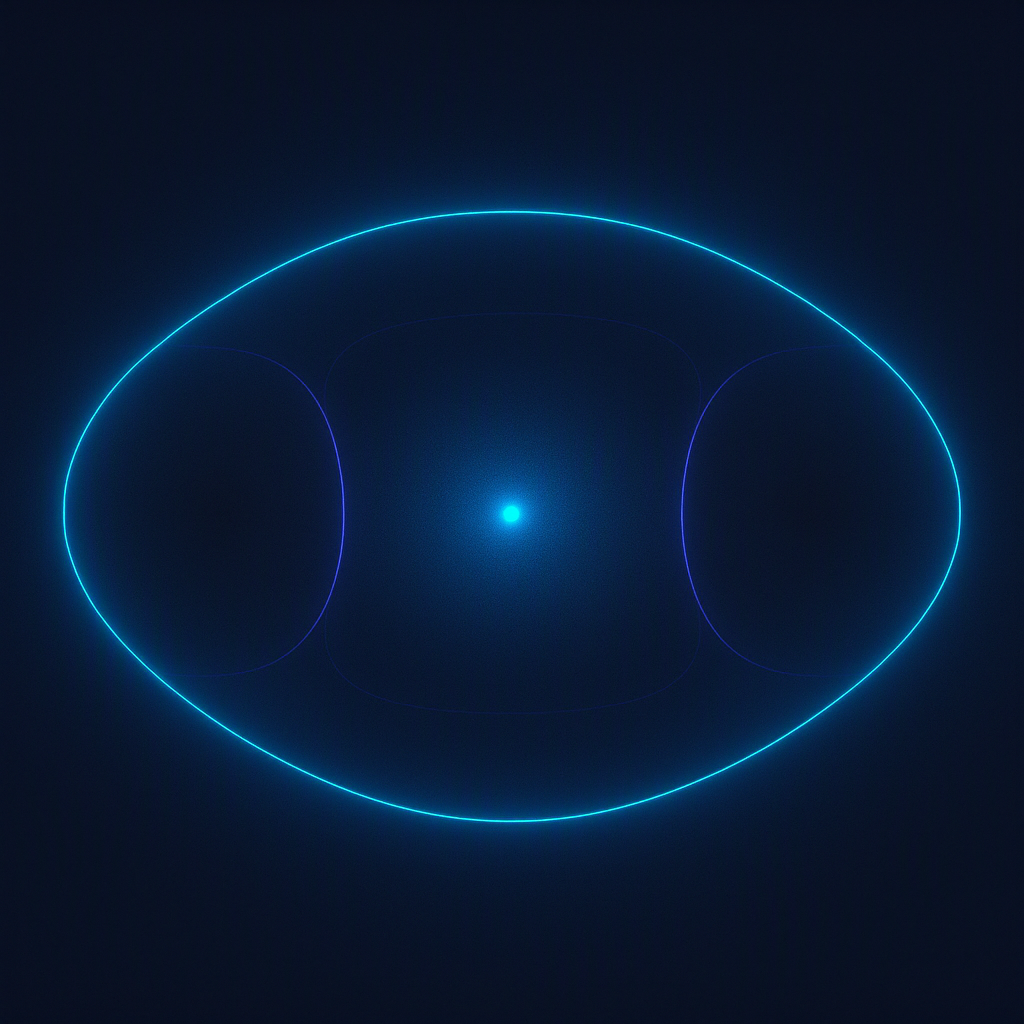
Visual clarity is essential to this project. Every diagram on this site was created specifically to illustrate the geometry of the model — curvature basins, membrane tension, neighbouring universes, and boundary‑region effects.
These diagrams are not artistic extras; they are part of the reasoning process itself.
Scientific Approach
This project is not presented as a finished theory, but as a structured proposal. It aims to be:
- Clear: Every concept is visualised and explained step‑by‑step.
- Coherent: All effects arise from the same geometric mechanism.
- Testable: The model makes predictions that can be compared with real data.
- Open: Feedback, critique, and alternative interpretations are welcome.
The goal is not to replace established cosmology, but to explore whether a simpler geometric explanation might account for the same observations.
About the Author
Derek Anderson Orr is based in Scotland and has long-standing interests in physics, cosmology, technology, and understanding how complex systems work. This project grew from a conceptual and visual approach to questions about gravity, dark matter, dark energy, and the large-scale structure of the universe.
The mathematical work on the site was developed later as a way of exploring what the original ideas would require physically and how they might be tested.
Outside of cosmology, Derek is also active in genealogy research, running, writing, and historical research.
Contact & Feedback
Constructive feedback is encouraged. If you have comments, questions, or scientific critique, please visit the Feedback page.